


Pregraphism and alphabet: manipulative activities for preschool children.
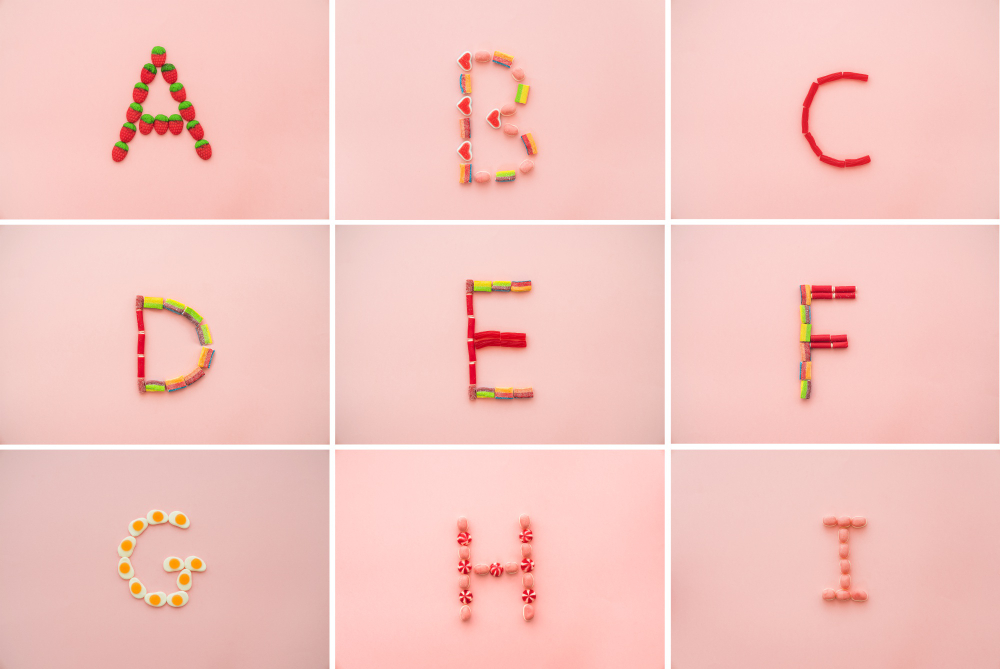
Discover the letters of the alphabet through manipulative materials.
Bring children in kindergarten closer to the alphabet, without impositions.
Every child has a special moment in which he or she begins to be interested in the alphabet, in which he or she observes, studies, transcribes the letters that he or she sees around him.
These early approaches to written code are beautiful to observe and actually occur at very different ages.
The wealth of stimuli that enriches our children, means that many come to the first grade with ideas already sufficiently clear on the alphabet, but not all follow the same path.
At the kindergarten, in fact, there are children who begin to write many words already at two, three or four years old and who do it completely independently, following their own inclinations and their own evolutionary path; Others, on the other hand, need to be accompanied in the discovery of the written code and supported in their commitment to enrich their own experience and knowledge.
To meet the needs of all children in kindergarten, the first proposal on the letters of the alphabet must be as playful and pleasant as possible, must take into account curiosity and interest, But it must also maintain that sensory approach that so enriches children.
Activity of pregraphism and play of the letters in a section of kindergarten.
As every year, when it comes time to propose the path on the alphabet, I start by disassembling a little' how much children already know about letters, helping them to focus not on repetition of sounds learned by heart, but rather to orient themselves towards all those sounds that come from their concrete experience and have a meaning for them.
We start with the names: our own and those of our companions, we continue with the names of the animals and we try together to find the initial letters of all these words: the name of the mother, that of a game and so on.
The intention is not to teach letters in the traditional way, but rather to trigger the switch of curiosity, involvement and interest, to bring each child to deepen independently, asking questions, finding answers, Building their own personal learning style.
So, even in the case of letters of the alphabet, games and proposals, work only if the approach is really interested and fun.
Building a sensory alphabet: playing with materials in kindergarten.
Activities for a week.
Monday: first approach to letters and alphabet collage.
The alphabet that will accompany us in this school year, has been prepared using different materials.
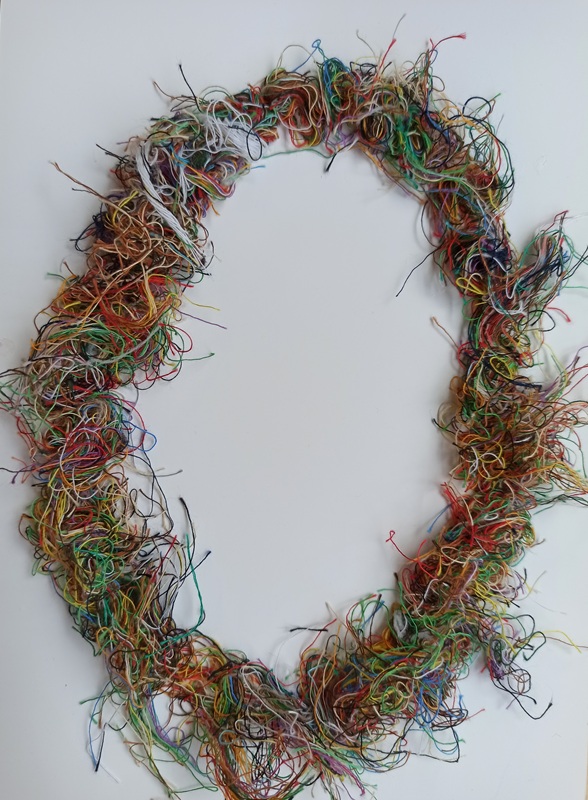
We chose carefully from what was available at school: wool, paper, pearls, thread, wood, cork, flour, salt, corn and everything that could be manipulated and glued.
Each child was offered a letter and a different material to paste, put together, the letters of all the children, went to create a rich and diverse alphabet, with many pleasant materials to discover.
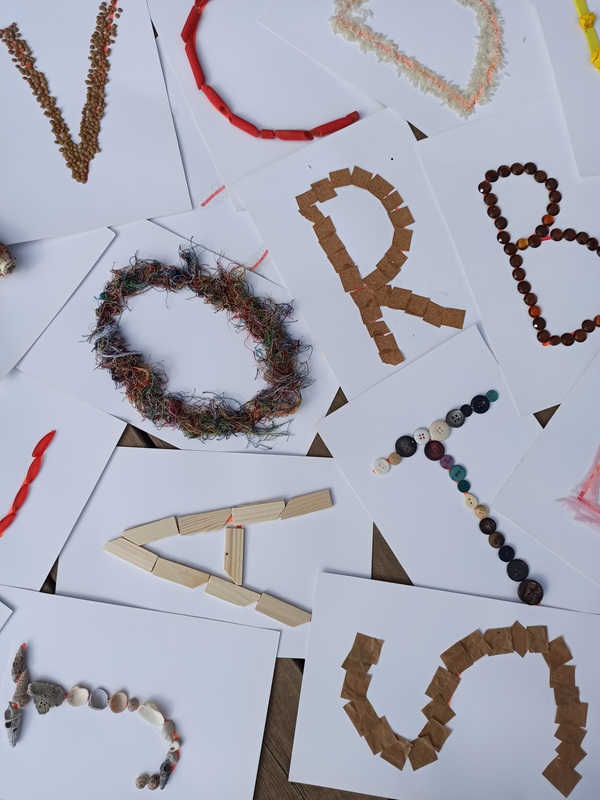
Before even starting the collage of letters, I introduced the proposal by throwing on the carpet, at the time of conversation, all the cardboard tiles with the alphabet, simply written in large dimensions.
I asked what they were and if anyone knew what they meant.
This first conversation resulted in the pre-assessment of children’s knowledge of the alphabet; This is always done in my group, before every proposal.
This helps me to take into account the difference in level between the knowledge of different children and allows me to follow each one as individualized as possible, valuing those who are already solid and supporting those who are still unripe.
After the conversation I asked the children to trace on a sheet of paper all the letters they already knew.
This first attempt, brings out with extreme clarity, both skills and graphic abilities, which are very different for each child.
This same table is valuable, to be preserved over the years, because it marks the exact moment in which, from an autonomous approach one passes to an intentional learning of the written code.
To achieve a result that brings out the children and their skills, we must leave all the time necessary to bring on paper what is already in thought, giving time and tranquility.
The curious thing is that the boys and girls in the course of this activity, were not even touched by the idea of copying from peers, each of them concentrated thoroughly, carrying on paper exactly what they could.
Tuesday: discover the letters of your name.
On Tuesday we literally threw on the paper the letters of our name and, in a completely random way, the letters of some comrades' names, copying them from the cards or from the objects around us.
Here again, an activity which may seem trivial but which, when proposed, stirs up commitment and concentration.
Some already master letters and full names, others struggle, but everyone recognizes how important it is to know how to put on paper letters and words, So no one pulls back and in a very natural way you leave a trace on the sheet of everything that has been identified to be letter of the alphabet.
In parallel to these graphic experiments, on Monday and Tuesday, the collage of all the letters of the alphabet was completed, built with different materials, which we will need in the next days to play with the letters.
Wednesday: animal game mimed with graphic dictation.
Once the alphabet was complete, the first game we used it for was that of animals to guess.
The teacher puts the card in front of him with a letter and mimics in a theatrical and funny way, an animal whose name begins precisely with that letter, the boys and girls have to guess which animal it is and then write on their own paper the letter.
The game is dynamic and participated, because it comes from a set of elements: the dramatization, the possibility to guess and then to grab the card with the letter, the graphic part in which you put your competence black on white.
I must say that the enthusiasm and the desire to guess, create a rather lively and chaotic atmosphere, maybe a little 'hard to manage, but that involves and engages everyone, not only those who are already capable.
Thursday sensory play: I write the letters in the materials.
For this activity I prepared a plate with different manipulative material for each child.
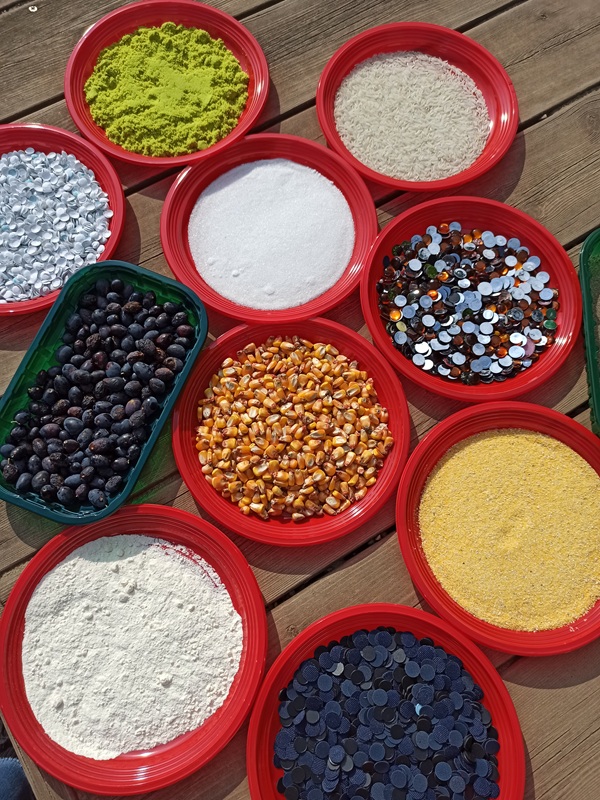
Using the letters the sensory alphabet, I proposed a graphic dictation to be carried out, but this time writing directly in the different materials with my finger.
For this activity our attention was focused not only on the correct pronunciation of sounds, emphasized and repeated over and over again, but also on the best way to trace letters, starting from top to bottom.
At the change of each letter there is a rotation of the materials: each child passes the plate to the right companion, in this way all children try all the materials and are intensely stimulated.
By pronouncing the letters correctly but emphasized, you have fun and, at the same time, you exercise the correct posture of the tongue and mouth.
Writing letters several times in different materials, you practice manual skills and live an intense sensory experience, which leaves a deep trace, as witnessed by the graphic reelaborations.
The boys and girls liked the game so much that we promised to repeat it.
Friday: experiment with my name and play with materials 2.
To train the writing of their name, I prepared a small grid printed with several lines, on which boys and girls could practice writing their own name.
For some, these are the first approaches; for others it is a well-established skill; for all this simple experiment, preserved and reproposed over the months, will leave a trace of graphic evolution.
The activity of tracing the letters of the alphabet in sensory materials was very appreciated by children, so we decided to propose it again but this time lived by children independently.
In turn, each child conducted the activity, choosing, if possible, naming and showing their peers a letter of the alphabet; After finding words that start with that letter and having virtually traced the letters in a correct way with the movement of the arm, we went to write directly into the plate with the material, over and over again.
Letting children lead the activity makes them especially responsible and attentive, and allows the teacher to focus attention on how individual children are tracked and correct any incorrect settings.
The container with the material does not have the characteristics of the sheet space but, in this first simple mode of writing, the incorrect traces are still highlighted, from below up or mirror; work with materials encourages corrections and allows repeated attempts, without the frustration of recognizing one’s own work as being bad or less good than that of others.
Repeating these activities over the months can be useful in documenting the evolution of learning.
If you want to deepen read also: Alphabet at kindergarten: from the body to the letters by building the Montessori alphabet.
Just one last note: in these sunny autumn days, we were able to carry out all these outdoor activities, using ourselves as a support for the graphic part of the tablets.
It seems counterintuitive, but when working outdoors, children are more concentrated and focused, enjoy the simple contact with the grass and sunlight, like to live the activities feeling part of nature, do not distract, do not agitate, simply live the moment with well-being.
Designed by Freepik