


First grade, how to help children arrive prepared.
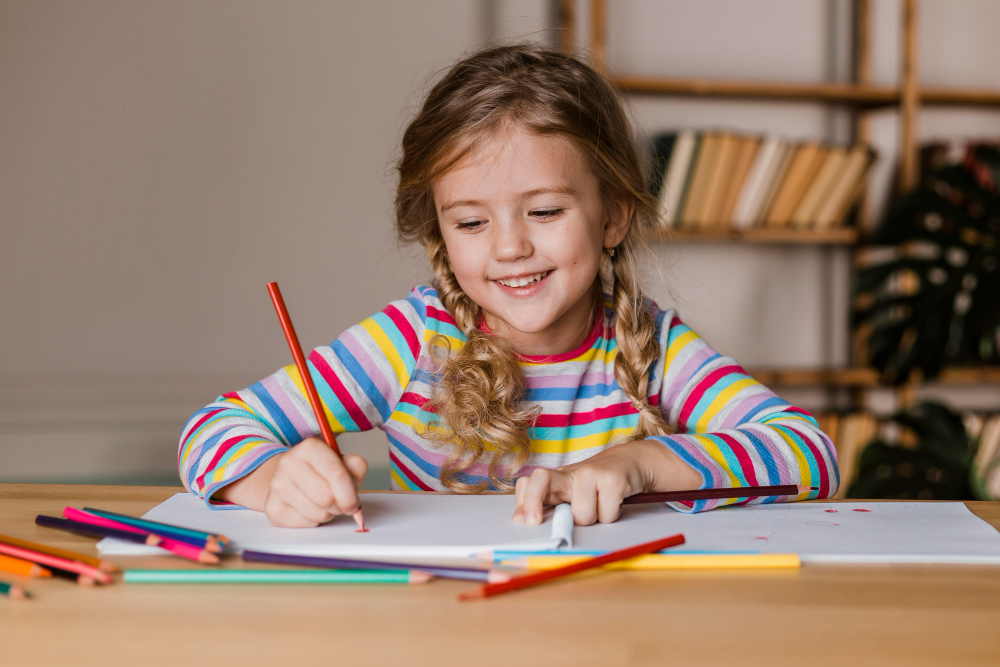
By the last year of kindergarten, children should have achieved some prerequisites necessary for a smooth transition to primary school.
How to tell if a child is ready for first grade.
During the three years of kindergarten, boys and girls complete an organic path, which leads them to develop countless skills in different areas of development.
The teachers, at the end of the cycle, share with the parents the achievements achieved and those still to be built, suggesting which activities to propose to the children to consolidate in them safety and skills.
Each comprehensive institution uses a different chart to measure and in some way evaluate the skills achieved by children. But what are these skills and what are the most relevant?
For simplicity I will focus on five major areas of development: autonomy, emotivity and socialization, global and fine motor skills, verbal and non-verbal communication, logic and mathematics, then for each of them, I will propose games and activities useful to implement them.
To understand if a child is ready to go into first grade it is important to keep in mind his path as a whole and remember that each individual child has a starting point and a trajectory of development and therefore also a different point of arrival.
The evaluation grids strive to offer criteria, but they do not exhaust the richness of each path and often, those who started from a disadvantage, proportionally go further than other more able and capable companions.
The following are therefore intended simply to be work ideas for children and parents and not tables measuring the value of a child.
Prerequisites: how do you know if a child is ready to go to first grade?
The prerequisites are basic skills or competences, necessary to structure more complex knowledge such as those required for learning reading, writing and disciplines that are generally offered in the first year of primary school.
The prerequisites are achieved through a slow and gradual educational path, which is structured from the beginning of the child’s life and not only in the years of nursery or kindergarten.
The skills needed to achieve the prerequisites can be exercised together with children, through a series of games and targeted activities, which can be divided into five major development areas.
Prerequisites and area of autonomy.
At the age of five, the child should already have some autonomy in how to dress himself or take care of his own personal hygiene.
At this age, however, certain skills should also appear that concern the autonomy of thought, linked to the construction of a good identity, such as being able to reorder spontaneously or be able to take initiatives in the game, understand the importance of some rules and know how to respect them, To be able to carry out an activity and concentrate.
If you feel that your child needs to strengthen his autonomy, train him to do as many things as possible on his own, help him only when strictly necessary, allow him to make mistakes and correct the throw, not replace him.
Activities to develop autonomy and concentration:
- Doing small chores like setting the table can help him feel more secure.
- Cooking together allows them to understand a series of cause-effect relationships in a pleasant way and teaches them how to measure strength and movement.
- Reading stories and reconstructing their passages, trains him to concentrate.
- Get help in everything he can do, it will make him feel capable and important.
- Allow him to do as many things alone as possible, it will make him capable and competent.
Prerequisites and area of emotionality and socialization.
These two aspects are of primary importance because, as we know, it is through serene relationships and good emotional development that the special experience of learning passes.
At the age of five, a child should be confident in school and have structured positive relationships with adults and peers; he should be able to ask for help when needed and know how to name his emotions; he should be able to share and work together in small groups.
Obviously many of these skills come from having a serene school path, but we can also work on it at home, with small steps.
Activities to promote social and emotional development:
- Dining without TV or video, to give space to sharing and dialogue.
- Starting with the story of our day, and then letting us tell theirs, will help us to build a lasting dialogue for years to come.
- Learn to observe our way of being with others to understand, as a result, that put into action by our children, who always observe us and learn from us.
- Offer as many opportunities to get involved together with other people: friends, acquaintances, family members but also strangers, always gives us new relational skills.
- Re-read together emotionally challenging, sad, funny, happy episodes and moments. Play the "game of emotions" to learn to understand your own and others' emotions.
Prerequisites and area of global and fine motor skills.
The area of fine and global movement at five years should also be quite refined.
Children should be able to master some dynamic patterns such as running, jumping, climbing, playing a position with their body, throwing and grabbing a ball, recognizing various parts of the body and being able to play them graphically.
To do this they will also have to possess some fine motor skills, which include the coordinated use of eye and hand such as: know how to use the gripper grip to properly hold pencils and markers, know how to cut out, thread pearls and strings, Paste and position the elements of an image correctly, fasten hinges and laces and last but not least, have a defined lateralization, that is to use predominantly the right hand, the left or possess a cross laterality and finally recognize the tactile qualities.
Activities and games to develop motor skills.
- Let the children play in nature, take walks and practice outdoor sports together.
- Propose sensory-perceptive activities of Montessori type, in all their declinations as those that I propose .
- Encourage spontaneous movement in all its forms: make trips on foot if possible, go up and down stairs, use tricycles and bicycles, accustom children to physical fatigue.
- You can build puzzles together, to refine the manual eye coordination.
- Choose images from leaflets and magazines to create collages and get used to cropping, pasting and composing.
- Encourage spontaneous artistic activities, such as drawing and painting, to help children graphically reproduce stories and experiences, improving their mastery of sheet space.
Prerequisites and area of verbal and non-verbal communication:
Language, in all its meanings, both verbal and non-verbal, is central because it helps to communicate and allows people both socialization and the expression of feelings and emotions.
For a five-year-old child, it is essential to first of all have acquired the ability to listen, tell stories and stories, but also the communication of peers and teachers.
This will then allow him to succeed in his turn, to tell personal experiences, report situations, repeat stories heard, read and describe images indicating who you are talking about, understand and execute three commands in succession, intervene in a relevant way.
The prerequisite for achieving all these skills is that language has developed in the right way.
If this did not happen it is essential to support the child in the recovery of missing skills, through a speech therapy or language education.
Activities and games to promote the development of language skills, verbal and non-verbal:
- Propose to the children phonological games like: it has arrived a vessel loaded with... something that begins by... A: rings, friends, animals etc.
- Chains of words like: say many names of animals that live in the forest, in the sea or in the sky.
- Games of riddles, in which the child hears a description and tries to guess, then in turn make a riddle, describing something, for example: what is white, cold and fluffy?
- Phonological games for the division into syllables, to locate the initial letter or letters of a name: with which letter begins your name? Cut out letters and recompose your own and other names.
- Reading stories for pictures: read his favorite book, not from the text but from the description of the illustrations. Who is the protagonist of the action, what says and what happens. All children can do it, even the youngest.
- Read, read and read again, to all children. Whenever you can.
Prerequisites and logical-mathematical area:
The area of logical-mathematical development in children does not have a theoretical development but is strictly linked to the body and movement, so since the child begins to move autonomously, his body helps him to read the reality that surrounds him also quantifying, measuring, weighing, Evaluating, calculating.
If we think about it the steps of a child measure space, when he puts in line his toys is evaluating the distance and path mathematically and geometrically, when he climbs lives three-dimensionality and so on.
So here too the importance of encouraging movement in children, especially spontaneous.
At five years the logical-mathematical skills are related to spatial organization, so know the topologic concepts to be able to organize the space sheet and perform, a graphic dictation for example: draws above the sun, below a meadow, above the lawn a house, Behind the house a tall tree.
To be able to reproduce graphically lived experiences, stories and situations, but also to be able to reproduce a given pattern, for example by copying a written word.
Classify objects by shape, color, size, know how to form sets defining the criterion used, recognize the intruder in a set, know how to quantify and count, recognize numbers and evaluate quantities, at least up to 10. Know the shapes and dimensions.
Activities and games for the development of the logical-mathematical area:
- Count and then define the quantities according to a criterion: count your puppets, are there more small ones? Are they less colored or brown? The big ones and the small ones are how many?
- Measure objects and paths, counting with the body: we count the steps, the steps that are necessary to go to the kitchen or in the bedroom, we measure the length of the garden by counting the steps, we measure the carpet putting the cars in a row.
- Make seriazioni together: we put the dolls from the smallest to the largest, the pastels from the highest to the lowest, the pots from the biggest to the smallest and vice versa.
- We build a set of cookies while having breakfast, a set of flowers while walking, a set of kitchen utensils while preparing dinner and so on.
- Let’s measure time: before, now, after. What happens at the beginning, during and at the end of the story.
A child who is preparing to attend the first grade of primary school can be helped to achieve the prerequisites, work less hard and have less anxiety by performing among these, the activities he needs most, those related to his areas of fall.
Not forgetting that we all have strengths and weaknesses, that characterize us and make us unique and that every child to grow and give the best of themselves, must be left free to learn according to their own times, their own cognitive characteristics and learning style.
Parents can be of great help in this by avoiding performance or assessment anxiety.
Designed by Freepik